
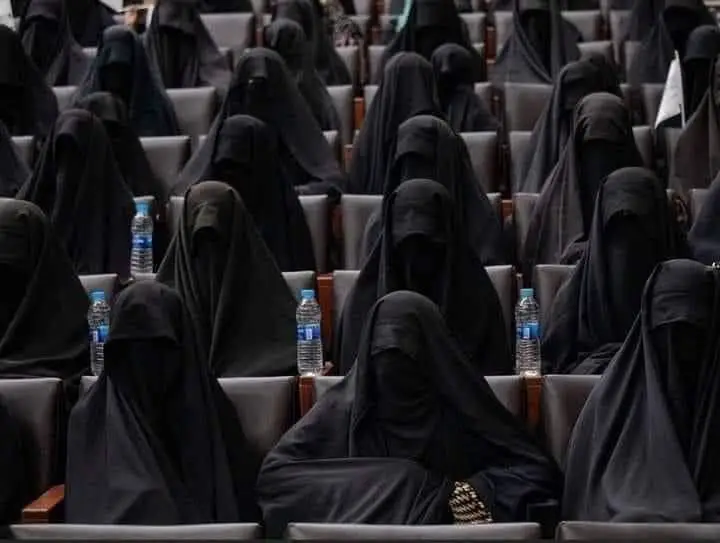

In a troubling incident, a female journalist was silenced and her image obscured during a live broadcast in Afghanistan on Tuesday, seemingly in compliance with the Taliban’s new morality law.
The law prohibits women from speaking or showing their faces in public.
During a news conference organized by the Taliban’s interior ministry, the state-controlled broadcaster RTA aired the voices and images of male journalists without issue.
However, when a female journalist from the Ariana news channel began asking a question, the broadcast abruptly went silent for over a minute, and the camera focused on the Taliban officials instead.
The audio was only restored when the officials started responding to her question.
No explanation was given for the interruption, and this has sparked fears that it may be the first public enforcement of the Taliban’s controversial morality law, which has drawn international condemnation.
The “Promotion of Virtue and the Prevention of Vice” decree, issued last Wednesday, imposes severe restrictions on women’s rights and personal freedoms, including Forbidding women from speaking aloud in public, singing, or reciting poetry, Requiring women to cover their faces and bodies in public, Prohibiting women from looking at unrelated men or being transported by taxi without a male guardian.
The law, based on the Taliban’s interpretation of Islamic law, considers a woman’s voice “intimate” and not suitable for public hearing.
Roza Otunbayeva, head of the UN Assistance Mission in Afghanistan (UNAMA), denounced the Taliban’s morality law on Sunday, calling it a “distressing vision” for Afghanistan’s future.
She criticized the law for further restricting women’s rights, deeming even the sound of a female voice in public a “moral violation.”
Otunbayeva also highlighted the broad powers granted to moral inspectors to threaten and detain individuals for vague infractions.
The Taliban introduced the morality law amidst their broader restrictions on women, including banning girls from attending school beyond sixth grade, prohibiting women from working in most fields and limiting public activities.
Otunbayeva emphasized that the Afghan people deserve better than to face threats or jail for minor infractions, especially amidst a humanitarian crisis.
This incident raises concerns about the Taliban’s increasing restrictions on women’s rights and freedom of speech.
Also, countries have refused to recognize the Taliban as the legitimate government of Afghanistan, primarily over their harsh treatment of women.

Olekanma Favour is a resourceful, self-motivated, and result-driven writer with a passion for crafting compelling narratives and insightful content. She loves tackling complex topics and weaving engaging stories.
When she’s not writing, Olekanma enjoys immersing herself in a good book, exploring new cuisines, and discovering new cultures.