
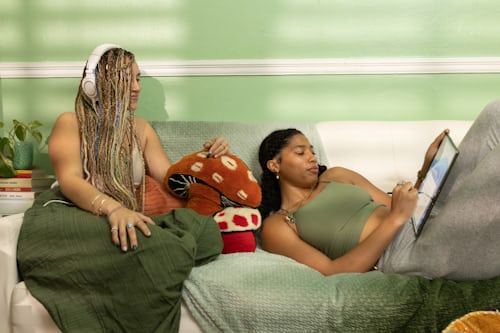

There are different things that can push women to want better and be better feminists. For some women, it can be watching movies about widowhood. For some other women, it can be watching documentaries and observing commentaries about feminism on social media.
For some women too, books and literature are the very things that encourage them to want better and demand that their voices are paid attention to.
In our latest listicle, Urban Woman Magazine asked some women to share the books that radically improved their feminism and confidence as women.
Read their responses below.
EC
Eat, pray, love was pivotal for me when I read it at like 13. It didn’t seem like much at the time until I had a conversation with a well-meaning classmate(another girl) where she was basically telling me that I would have to marry early because something something about how women are flowers.
Before then, marriage and all that was a very, very distant idea to me, something I never consciously thought about.
That conversation prompted me to consciously think about it, to do the age calculations i.e going to uni, doing nysc, working and making my own money(because shalla to my elder sisters, the idea of going straight from uni to a man’s house never even crossed my mind).
At the end of all my calculations, I figured that I would just be crossing the age benchmark that my friend had given me, yunno, before the flower stops blooming or whatever.
The only glitch was that Eat, pray, love had put in my head the idea of a woman traveling for herself without having to consider any familial obligations, and I knew I wanted that for myself.
I now said okay, what if I marry around this 23/24 age range that this girl has given me, but then I travel with whoever I marry before we have children?
No, I thought to myself, because I most probably will field crazy inlaws who will want us to have children immediately.
I said okay, what if we have the children and travel with them, eat-pray-love style?
It still didn’t work for me because I just felt like children should have more stability(in terms of place) than that.
Omo, after all the many many calculations and permutations, I came to the conclusion that I will not even begin to remotely think about marriage till I am at least 30, till I get to a point where I am fully taking responsibility for and inhabiting my own life like the protagonist of that book.
Her search for meaning came after a divorce in her 40s, so I don’t know why 13yo me was so sat for the idea, but I really was. Still am even.
BZ
– Tomorrow I Become a Woman. I cried so much and swore no man would ever treat me that way.
– Joys of Motherhood. Ọmọ in everything na Adaku still win. Also it was while reading this novel that the idea of having *only* daughters came to me. I mean, I won’t be aborting boy fetuses or anything, but damn – if I had a choice I’m gonna be a girl mom only. (I know this is controversial sha🌚🌚).
– Half of a Yellow Sun – I think it’s interesting how Olanna and Kainene could choose to make the best out of situations they found themselves in. And the fact that the men they were with did not subsume who they were. That’s kind of what I came away with.
– House of Symbols (Akachi Adimora – Ezeigbo) – Eaglewoman! Definitely an inspiration to work hard and strive to fulfill my goals.
– Ahhh did I forget Purple Hibiscus? Kambili’s coming of age foreshadowed mine – I think it did so for all of us from troubled homes
– A Thousand Splendid Suns – I don’t need to talk much sha. But misogyny is universal, with each culture having its own special flavour. Destroying and subverting it is an eternal task, one that so many in our past had to grapple with so that it could be easier for us now.
– Uncle Tom’s Cabin – this one was my introduction to racism – and transatlantic slavery. What I came away with was this – no matter how much you care for your oppressor (as Uncle Tom cared for the white families who owned him, and later sold him to his eventual death), no matter how much you look like your oppressor or claim kinship (as the mixed race enslaved people did), you will NEVER be free so long as the system that placed them above you remains in place.
I try to apply this rule in the race for women’s rights.
We may claim to be useful (for our labour), or to hold ties of love, kinship and friendship with men, but when push comes to shove, patriarchy will wound you in shocking ways.
DA
First book was A Doll’s house by Henrik Ibsen, although written by a man.
The line that changed everything for me was, “I have been your doll-wife, just as at home I was Papa’s doll-child.”
I remember crying when I realised I was slowly morphing into Nora, the protagonist. I’ve seen the life with my mother—unfulfilled and I didn’t want the same for me.
Nora leaving the marriage into uncertainty just gave me some sort of assurance that my life would continue if I just decided to take that leap of faith.
JZ
Oh it was Second Class Citizen which prompted me to read Joys of Motherhood for me. I felt every form of emotion from anger to disappointment to relief and anger all over again.
TA
Fifty Shades of Grey.
It improved my sexual confidence and fantasies as a woman.
I read the trilogy annually as a ritual. It’s one of the first set of books I got when I decided to start building my library with intentionality.
The Stillborn.
Validated my dreams, and me to know that it is ok to dream as a woman and girl child, have them big and wild, and to achieve them.
God’s Bits of Wood.
Women who are not afraid to challenge the status quo. I actually used this book for my undergrad project; read it in 200L and marked it as one of the books I was going to use for my project.
SM
Buchi Emecheta’s Joys of Motherhood: made me realize that there’s no joy in motherhood for me. It was one of the many examples that, as someone who cares little for kids, counted as a stroke against the ideal. The thought of getting babies put in me, popping them out, then having to take full responsibility because their sperm donor is an incel would end me.
Mariama Bâ’s So Long A Letter: Ah, just men being men. Possibly the most upsetting part of being a heterosexual feminist is having to deal with men intimately. Mariama Bâ explores betrayal in love, especially when one is convinced their love is superior because the man they’re involved with is superior—educated, liberal facing. It put the marriages of two women into perspective, and the reality of it was gobsmacking. These are every day stories in West Africa especially. It moved me to begin to look at my relationships with men objectively—for every man I’ve ever loved, and everyone I miss, what I do is the version of me that I was when I was with them. The very essence of these relationships was, and continues to be me. It radicalized me to take men off the pedestal that Disney and my African mother taught me to put them on. That way, Ramatoulaye would have not expected more from a Muslim Senegalese man (no shade to my ex).
Virginia Woolf’s A Room of One’s Own: “A woman must have money and a room of her own if she is to write (fiction).” Not a husband’s, not a daddy’s, unburdened by the responsibilities of wife, mother, daughter. That is all.
Khaled Hosseini’s A Thousand Splendid Suns.
Love between women is the way to conquer the ire of men. Khaled Hosseini is very wise for a man. Throughout the book, he gives invaluable motherly insights through the vehicle of prose.
Maya Angelou’s Heart of A Woman: Text I sent to a friend after reading it: I kept muttering “you are a more patient woman than I, Maya Angelou”. The dynamic of this relationship between herself and Mr. Maké, and her thought process (never justifications) almost made me a believer.
A year into their marriage, a man enamored by her, who did everything in his power to marry her, despite her being engaged to another, began to cheat on her, blatantly. When questioned, he did not shrink into denial nor feign repentance, he simply went on with his day and let the woman “sort herself out”.
And that’s not all, he got them into one too many financial fixes, and because of an ego that managed to be larger than his belly, he went into mad debt to keep up appearances—after convincing her that the wife of an African man does not work. An attractive intellectual though he was, sparkling chemistry though they had, excited about the prospect of an exciting life between two individuals driven by a similar if not same force, their union descended into something I hope that man regretted until he died. But I’m not here to hate on that and them, I’m merely thinking.
About the sacrifices that need to be made for marriages to stand, about how the woman automatically adopts the role of the high priest, about how truly, inconvenience is the cost of community, and when this “community” is overpriced. When do we get to say “yeah, that’s the line for me”, and is the line for her same as the line for me? Some women condone cheating, some do not. Not in the slightest. (I’ve found myself wondering which one I am, lately.
The thought of a mildly polyamorous romance sounds enticing. The STDs do not. The possibility of a partner falling in love with another while with you and leaving with said other, I am mildly indifferent about. The roles could be reversed, and I would hope him as understanding. But as always, I digress).
Maya had no reason to be chained to this man. None of the typical reasons anyway. She did eventually defy him cunningly and start working, but even without that, as a known and respected citizen of the United States, she did not have to tolerate any of that.
Furthermore, she lost love for the man. Respected admiration among “peers” was what remained of the butterflies. Hell, she didn’t even need to leave Africa if she didn’t wish to (she’d moved to Cairo with him after their marriage), she was self sufficient. But she endured a while yet. And it all seemed so foolish at first, but then I started noticing how life went on despite her singleness, and life went on after her marriage. Life goes on, we just be living it.
Men as partners in all tiers (from bedwarmers to lawfully wedded husbands) are just that—experiences. As simply as an occurrence influences some choices, some stances, providing learning and unlearning opportunities, so does coupling up. And while we might have varying levels of tolerance to different things, especially actions of the individuals we’ve chosen to keep in close proximity of us, at the end of the day, it is up to us as individuals to decide what stands and what either has to fall or would fell this union. It is a most personal decision to make.
Kate Chopin’s The Awakening: Excerpt from a review of the book I wrote some three years ago still ring true: Edna Pontellier’s definition of the mother-woman as a state of blind contentment, a state which could never admit life’s delirium rang true to me, a sole believer in the need for allowance for delirium to be. Her resolve to never again “belong” to another, but herself resonating deeply. Enthralled by the flow from the unfurling of her sensuality to a freeing of her body, eventually sexuality and most importantly, a reconnection to the artist within, I would have bet all the money I own on an immediate divorce doing her nothing but good, if only I too wasn’t raised to “think about the children”…wife-hood in my community is something I have had sentiments harboured against since age 14, 10 maybe. A routine, at first experienced with bliss, then robotically as the “joy of womanhood” slowly becomes a life rid of self. A process so self-negligent, it’s damning.
Angel Nduka-Nwosu is a writer, journalist and editor. She moonlights occasionally as a podcaster on As Angel Was Sayin’. Catch her on all socials @asangelwassayin.