
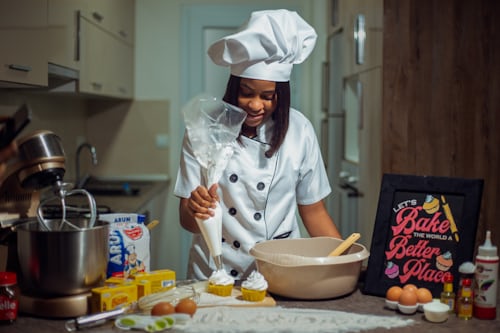

In 2018, I became a lot more active on social media apps like Twitter and Instagram. It was from Twitter that I saw firsthand how female chefs and cooks often experience discrimination.
Chef Stone, a popular chef on Twitter, narrated how the female chefs and cooks in his circle often experienced salary delays and outright denial of employment in certain restaurants in Nigeria.
Hearing it was both shocking, not surprising and sad to hear all at the same time. This is because a part of me always nursed the idea of being in a cooking show and owning a catering business.
It did not totally surprise me because I had experienced being told by outsiders that I’ll make a good wife when I cooked nice food. When my brother did? It was all talks of how he could make a good chef and as such should be sent to culinary school.
One thing that stands out for me in all of the above is how no one ever questioned why it was often women who had to cook for the family day in and day out and be unpaid while at it.
This disparity is what Chimamanda Adichie mentioned in her Ted Talk We Should All Be Feminists when she said; “I was going to say maybe women are born with the cooking gene. Until I remembered that the majority of cooks in the world; those we give the fancy title of “chefs” are men”.
Now fast forward to seven years later, due to influences from chefs like Hilda Baci, I went back to my dream of owning a catering business. I founded a business called Aviazu’s Kitchen where I make bulk soups, stews, porridges and standalone spiced proteins. I have also begun offering my services to more established cooks and chefs who need an extra hand to meal prep at events.
Seven years later and the disparity and poor treatment of female cooks and chefs still abounds. For one, I know female chefs who find it difficult to gain employment because restaurants refuse to hire women.
Then there are those who downplay the hardwork of both caterers and chefs by often referring to women who cook as “ordinary caterers”.
Come to think of it, I have never heard anyone call a man who is a chef a caterer. I am indeed a small-scale caterer but it seems to me that that word has negative gendered connotations. Do we even want to talk about the risk of sexual harassment and assault that female private chefs are exposed to when doing their work?
Or those who somehow foolishly conflate being a private chef with being a sex worker and demand sex from private chefs? Or those whose shaming of “Instagram chefs” seem to be directed at only women chefs and cooks?
If cooking and being in the kitchen are seen as the purview of women, then why do women encounter discrimination, violence and underpayment when they do choose to cook for a living? Does that not point to the reality that gender roles are not natural but are rather forced and inhumane constructs?
Speaking with Ufuoma*, she narrated how she was underpaid as a chef.
In her words: “I just want to talk about the time where I was a chef/cook last year at a hotel in Ebonyi State.
My own was that I was very very underpaid and used. I worked for a month though. The salary was 30k. But in the end I got 7k.
When I asked why they said it’s because of shortage.
In hotels they always measure everything down to how many cubes of Maggi you use.
Using anything out of that will give you a penalty of “shortage” the next time you want to cook.”
She went on to say: “If anything went missing, you would pay for it even if the kitchen was accessible to everyone. If rats ate the noodles, you were held accountable for it.
Now, I used to cook from 6am to 12am and even up to 3am on peak days like Sunday and Friday. No kitchen assistant, only one chef, which was me.
When I got paid 7k was when I knew that these people were wicked.
I left. It was a survival job but I couldn’t even do it.”
The truth is that the patriarchy was never created for women to thrive. And this includes even the ability to thrive in areas marked feminine.
For women to be truly respected as cooks and chefs, we must start with questioning the belief that cooking is gendered and the general idea of gender roles in itself.
*Name changed to protect identity
Angel Nduka-Nwosu is a writer, journalist and editor. She moonlights occasionally as a podcaster on As Angel Was Sayin’. Catch her on all socials @asangelwassayin.