

The Taliban leaders in Afghanistan are tightening restrictions on women’s voices in public, implementing new strict laws under the Islamist regime.
These laws, approved by supreme leader Hibatullah Akhundzada, touch on various aspects of daily life such as public transportation, music, grooming, and festivities.
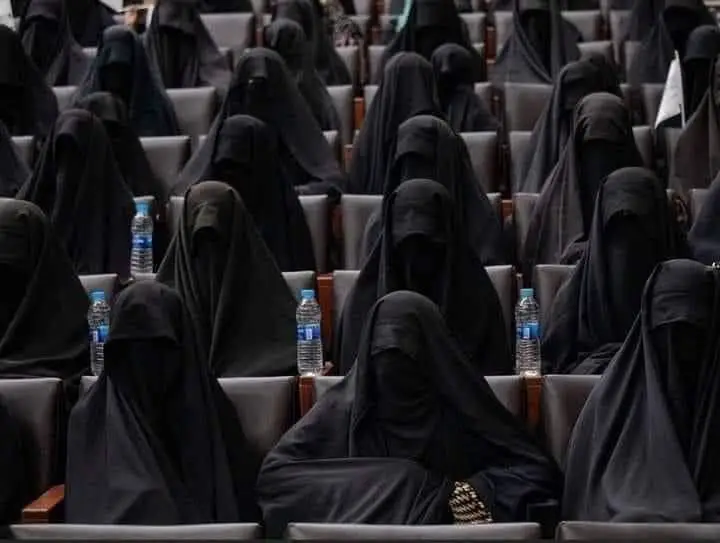
Article 13 of the new regulations focuses on women, requiring them to cover their bodies in public and wear face coverings to prevent temptation.
The rules prohibit thin, tight, or short clothing and mandate that women conceal themselves from non-Muslims.
Additionally, women are advised not to sing, recite, or speak loudly in public, as their voices are considered private.
It is also forbidden for women to make eye contact with unrelated men.
The 114-page, 35-article document obtained by The Associated Press marks the initial official proclamation of vice and virtue regulations in Afghanistan following the Taliban’s assumption of power in 2021, coinciding with the establishment of a ministry dedicated to these principles.
These laws grant the ministry authority to oversee individual behavior directly, imposing penalties such as warnings or arrests when officials claim Afghans have violated the statutes.
The laws in Afghanistan prohibit the display of images of living beings, playing music, solo female travel, and mingling of unrelated men and women.
They also mandate prayer for passengers and drivers.
There is also an emphasis on promoting Islamic virtues like prayer and wearing hijab, while discouraging vices against Islamic law.
The U.N. report criticized the ministry for instilling fear and expanding control over public life, including media censorship and anti-drug efforts.
The U.N. expressed concerns, particularly for women and girls, despite the Taliban’s rejection of the report.
“Given the multiple issues outlined in the report, the position expressed by the de facto authorities that this oversight will be increasing and expanding gives cause for significant concern for all Afghans, especially women and girls,” said Fiona Frazer, the head of the human rights service at the U.N. mission in Afghanistan.
These laws, approved by supreme leader Hibatullah Akhundzada, touch on various aspects of daily life such as public transportation, music, grooming, and festivities.
Article 13 of the new regulations focuses on women, requiring them to cover their bodies in public and wear face coverings to prevent temptation.
The rules prohibit thin, tight, or short clothing and mandate that women conceal themselves from non-Muslims.
Additionally, women are advised not to sing, recite, or speak loudly in public, as their voices are considered private.
It is also forbidden for women to make eye contact with unrelated men.
The 114-page, 35-article document obtained by The Associated Press marks the initial official proclamation of vice and virtue regulations in Afghanistan following the Taliban’s assumption of power in 2021, coinciding with the establishment of a ministry dedicated to these principles.
These laws grant the ministry authority to oversee individual behavior directly, imposing penalties such as warnings or arrests when officials claim Afghans have violated the statutes.
The laws in Afghanistan prohibit the display of images of living beings, playing music, solo female travel, and mingling of unrelated men and women.
They also mandate prayer for passengers and drivers.
There is also an emphasis on promoting Islamic virtues like prayer and wearing hijab, while discouraging vices against Islamic law.
The U.N. report criticized the ministry for instilling fear and expanding control over public life, including media censorship and anti-drug efforts.
The U.N. expressed concerns, particularly for women and girls, despite the Taliban’s rejection of the report.
“Given the multiple issues outlined in the report, the position expressed by the de facto authorities that this oversight will be increasing and expanding gives cause for significant concern for all Afghans, especially women and girls,” said Fiona Frazer, the head of the human rights service at the U.N. mission in Afghanistan.
Olekanma Favour is a resourceful, self-motivated, and result-driven writer with a passion for crafting compelling narratives and insightful content. She loves tackling complex topics and weaving engaging stories.
When she’s not writing, Olekanma enjoys immersing herself in a good book, exploring new cuisines, and discovering new cultures.