
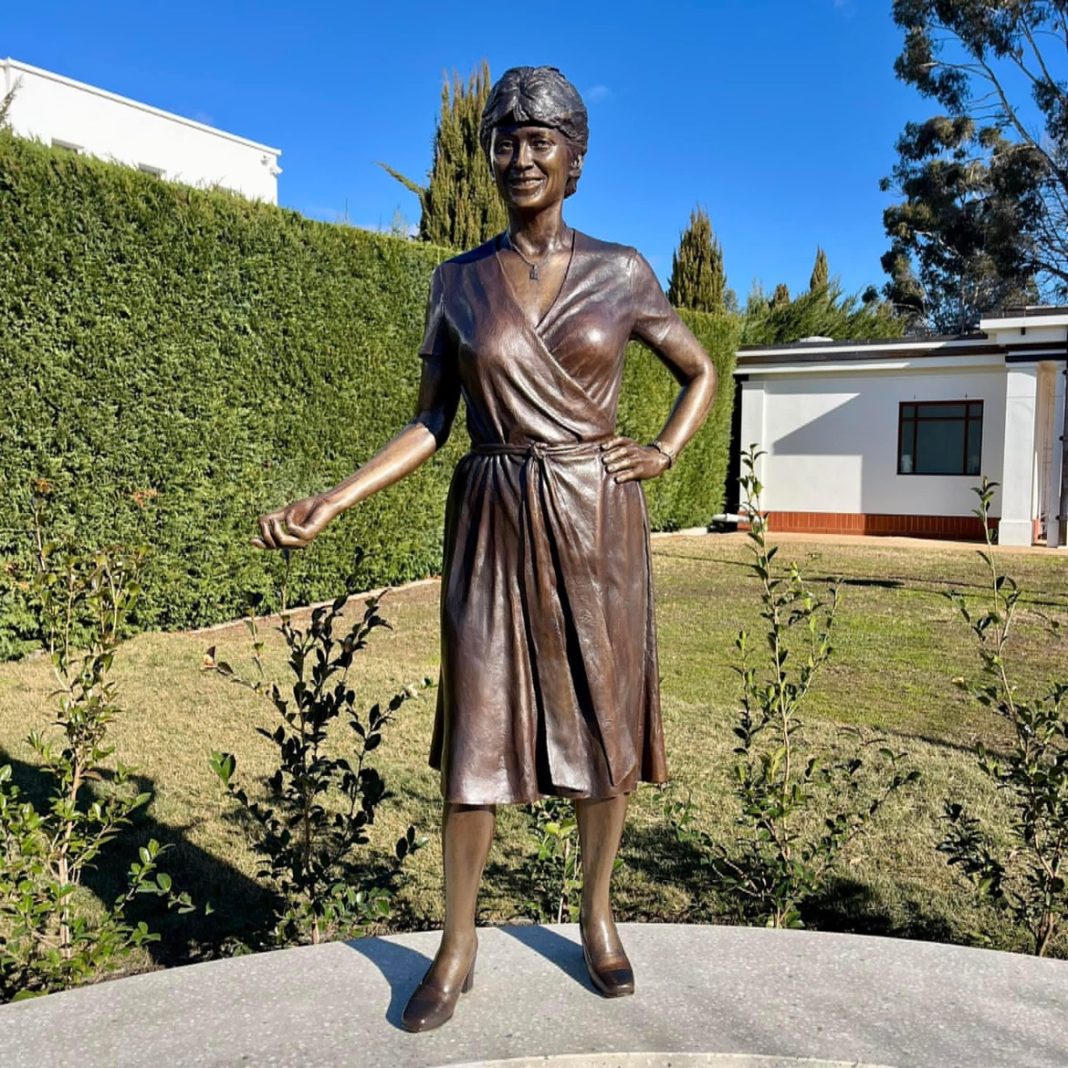

Pioneering trailblazer Susan Ryan shattered glass ceilings and defied convention, embodying the empowering slogan: ‘A woman’s place is anywhere decisions are being made.’
As the ACT’s first female Senator, she broke barriers by becoming the first woman on Labor’s frontbench and in the cabinet.
Her groundbreaking legacy continued as the first Minister for Women, a role she championed with passion and dedication.
Ryan’s indelible mark on Australia has been immortalized with a stunning statue in the Canberra parliamentary triangle, capturing her iconic address at a 1977 women’s work rally.
The beautiful Lis Johnson sculpture stands proudly in the old parliament house’s Senate rose gardens, a place where Ryan’s children fondly remember playing as kids.
In the iconic sculpture, Susan Ryan proudly wears a wrap dress, the latest women’s fashion trend in 1977, designed by the legendary Diane von Fürstenberg just months prior.
Von Fürstenberg’s inspiration came from Julie Nixon Eisenhower’s confident defense of her father, Richard Nixon, wearing a wrap top and skirt. This chance encounter led to the creation of the wrap dress, revolutionizing women’s fashion forever.
Ryan, a champion of equality, often wore this style while campaigning for women’s rights, leaving an indelible mark on Australian women’s lives. Both Ryan and von Fürstenberg are now immortalized in Australia’s national capital, their legacies intertwined.
As a senator, Ryan courageously introduced a private member’s bill for a sex discrimination act in 1981, paving the way for future progress.
Later, in 1983, she spearheaded the campaign and introduced the groundbreaking Sexual Discrimination Act, explicitly recognizing sexual harassment as a form of actionable wrong – a first in Australian history.
Despite facing a misinformation campaign that absurdly claimed the legislation would turn Australia into a communist dystopia, where women would be forced into labor camps and children raised by strangers, Susan Ryan and the Hawke government remained steadfast.
On August 1, 1984, their perseverance paid off as the groundbreaking Sexual Discrimination Act became law.
The Canberra Times marked this historic moment with a 264-word article on page 17, heralding the new era of protection for workers.
The legislation empowered individuals to push back against sexual harassment, including crude comments and bottom slapping, which could undermine their confidence and make their work life unbearable.
Ryan’s tireless advocacy for gender equality continued until her passing, driven by a deep sense of injustice that she felt “in her bones”.
Susan Ryan’s legacy as a champion of justice lives on through her sculpture, which proudly takes its place alongside those of men, symbolizing the triumph of women’s achievements.
The ACT’s innovative “Recognising Significant Women through Public Art Program” funded the sculpture, continuing Ryan’s trailblazing tradition.
Last year, Dame Enid Lyons and Dame Dorothy Tangney made history as the first Australian women to be honored with a statue in the parliamentary triangle, joining a pantheon of former prime ministers.
However, this milestone also highlighted a striking disparity – until then, more dogs than women or Indigenous people were recognized in the National Triangle.
The inclusion of John Gorton’s beloved kelpie-cross Susie Q sparked a campaign to rectify this imbalance, paving the way for more women and Indigenous leaders to be celebrated in this iconic space.
As the ACT’s first female Senator, she broke barriers by becoming the first woman on Labor’s frontbench and in the cabinet.
Her groundbreaking legacy continued as the first Minister for Women, a role she championed with passion and dedication.
Ryan’s indelible mark on Australia has been immortalized with a stunning statue in the Canberra parliamentary triangle, capturing her iconic address at a 1977 women’s work rally.
The beautiful Lis Johnson sculpture stands proudly in the old parliament house’s Senate rose gardens, a place where Ryan’s children fondly remember playing as kids.
In the iconic sculpture, Susan Ryan proudly wears a wrap dress, the latest women’s fashion trend in 1977, designed by the legendary Diane von Fürstenberg just months prior.
Von Fürstenberg’s inspiration came from Julie Nixon Eisenhower’s confident defense of her father, Richard Nixon, wearing a wrap top and skirt. This chance encounter led to the creation of the wrap dress, revolutionizing women’s fashion forever.
Ryan, a champion of equality, often wore this style while campaigning for women’s rights, leaving an indelible mark on Australian women’s lives. Both Ryan and von Fürstenberg are now immortalized in Australia’s national capital, their legacies intertwined.
As a senator, Ryan courageously introduced a private member’s bill for a sex discrimination act in 1981, paving the way for future progress.
Later, in 1983, she spearheaded the campaign and introduced the groundbreaking Sexual Discrimination Act, explicitly recognizing sexual harassment as a form of actionable wrong – a first in Australian history.
Despite facing a misinformation campaign that absurdly claimed the legislation would turn Australia into a communist dystopia, where women would be forced into labor camps and children raised by strangers, Susan Ryan and the Hawke government remained steadfast.
On August 1, 1984, their perseverance paid off as the groundbreaking Sexual Discrimination Act became law.
The Canberra Times marked this historic moment with a 264-word article on page 17, heralding the new era of protection for workers.
The legislation empowered individuals to push back against sexual harassment, including crude comments and bottom slapping, which could undermine their confidence and make their work life unbearable.
Ryan’s tireless advocacy for gender equality continued until her passing, driven by a deep sense of injustice that she felt “in her bones”.
Susan Ryan’s legacy as a champion of justice lives on through her sculpture, which proudly takes its place alongside those of men, symbolizing the triumph of women’s achievements.
The ACT’s innovative “Recognising Significant Women through Public Art Program” funded the sculpture, continuing Ryan’s trailblazing tradition.
Last year, Dame Enid Lyons and Dame Dorothy Tangney made history as the first Australian women to be honored with a statue in the parliamentary triangle, joining a pantheon of former prime ministers.
However, this milestone also highlighted a striking disparity – until then, more dogs than women or Indigenous people were recognized in the National Triangle.
The inclusion of John Gorton’s beloved kelpie-cross Susie Q sparked a campaign to rectify this imbalance, paving the way for more women and Indigenous leaders to be celebrated in this iconic space.
Olekanma Favour is a resourceful, self-motivated, and result-driven writer with a passion for crafting compelling narratives and insightful content. She loves tackling complex topics and weaving engaging stories.
When she’s not writing, Olekanma enjoys immersing herself in a good book, exploring new cuisines, and discovering new cultures.